Friday, January 28, 2011

Sound Treatment

Logline

This will take place at crystal springs trail on a bench overlooking the spring. Near sunset, since sun sets over the springs

General ideas continued from where left off-
Then middle age couple walks by in the background from right side. The boy doesn’t notice, but they talk about how they always love coming back to this trail and how peaceful it is.
Boy is looking out at the spring as they are walking by and finish
Then old couple walks by from left side and they sit down next to the boy on the bench. Boy takes off his headphones and says sure you can sit here.
Old couple are talking and they are audible and they are talking about how much they enjoy each other, boy puts his head back down in his hands still in distress. Old people respond. Old man tells him some words of wisdom about relationships (not too cliché) maybe some humor about himself and his wife. Old lady says time for us to go, so they both get up, old man tells boy it will be “alright kid pull through”.
After they leave out of the WS. All isolated sounds. Boy relaxes back in his park bench and looks at the spring again (hears small sound of waves). Boy looks at Grass and hears the sound of crickets, and soft wind sound as wind is blowing nearby grass. (if theres no wind it will have to be man made and sound effect can be put in later). Boy looks at free way in back of him and notices sound of cars passing by. Boy looks out at the spring once again and now all sounds are audible. Boy pulls phone out of his pocket with right hand. Looks at it (seems like he is contemplating something) then puts phone down, face down, on his right leg and slouches further back in bench. ONLY THING AUDIBLE Phone starts ringing (ringtone differences genuwine). Boy turns his phone back over and looks at the front and caller ID says Katy and picture is of boy and Katy smiling (happy). Boy looks at it then looks out at spring and left to right (now all previous sounds in green are heard) then he looks back at phone (only ringtone is heard) boy sighs and pushes silent on his phone. (WS from beginning) Gets up and walks out of frame. Time lapse until night time then fade out.
WS- the sun will outline the boy in black and the area around him is in light.
Boy walking (head down) sits down on park bench.
FROM HERE ON 180 line shouldn’t be crossed until final scene. CU
Boy sitting down (sighing)
CU different side
Boy putting face in his hands (distressed)
WS in front of boy
Young couple walks by in background, they come from the left side (can hear them talking how much they like each other)
Dollying of couple walking
Continue how much they like ea other
WS
Boy turning as couple walks away so he only sees their backs (they don’t see him)
CU
Boy shaking his head, pulls out ipod
CU of one side of his ear
puts his head up plugs in his head phones (we can hear his music- sad heartbroken stuff)
Published with Blogger-droid v1.6.6

Monday, January 24, 2011

Part I: Director's Influence

The Aviator is definitely a biopic centered around the life of Howard Hughes, an eccentric movie director and aviation pioneer. This film definitely depicts characteristics of a biopic because whenever the time period in the film shifts forward, filters are constantly changing. Filters are used to indicate the time period that the film is taking place in. This work takes place among other great biopics that depict a prominent character during history. This film, lie many others, doesn't stay in one period of history. Instead, the Aviator depicts various time periods and shows how the character adapts to the changing times.

Martin Scorsese is no new name for many film fanatics. His work includes Goodfellas, The Departed, and the recent Shutter Island. Many of his films shows the gritty side of whatever he is trying to depict. To the general public, aviation seems like a heroic undertaking. But as we see in the film, Scorsese shows the pains and struggles that Howard Hughes has to go through in order for his investments in his planes succeed.

A definite theme of The Aviator has to be that struggles must be overcome in order for one to stick to their goals and pride. Hughes manages to overcome heartbreak, his disorder, and near death experiences in order for him to pursuit his aviation dreams

Saturday, December 4, 2010

The Hurt Locker Analysis

Before I begin taking a critical look at this film, I just want to say that The Hurt Locker is easily one of the best war flicks I have ever had the pleasure to watch. It was extremely effective in how it portrayed the psychological effects that war had on soldiers, on top of shedding a little bit of light on modern warfare. It is a highly relevant film in a time period in a America where war is a subject that very little people have any knowledge about. This allows for the common man to experience war from the perspective of soldiers.


Kathryn Bigelow may not be a well known name for most people. Her previous roster of work varied from TV shows to shorts to full feature films. One can say that she has had a broad range of experience to draw from to create this film. It is also important to note that none of her previous work has received as much critical acclaim that The Hurt Locker did. She may not be a well known name yet, but I suspect she soon will be, for many studios will be offering her opportunities to direct films for them.

This film was made so recently, and in a time where the film's relevance speaks to a country that has been engaged in a war that has been going on for far too long. The Hurt Locker not only takes a look at life on the battlefield, but also at some of the families at home who are directly being affected by war. This speaks to the families at home watching this movie and gives them a look at possibly what their family members are going through in Iraq. Most other films in this same setting were merely documentary style, and without a real storyline with character development. It is also important to note that although the film portrays very realistic war environment, some war veterans have dismissed the inaccuracies of the film. Nevertheless, the setting of the film is merely a backdrop to the tension filled plot line and riveting character development.


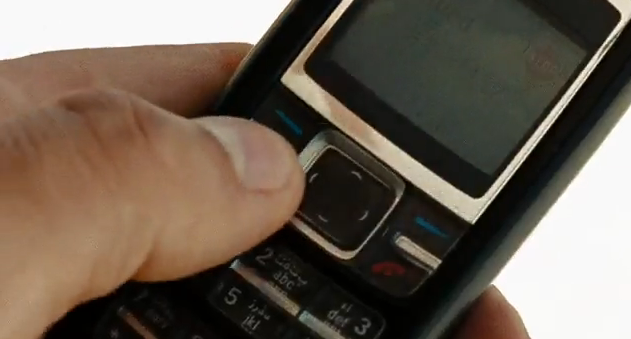
The Hurt Locker took a very interesting approach to the cinematography. Instead of striving to create smooth shots, the cinematography was shaky, as though it were a home movie. I really liked this approach because it gave the movie a stronger sense of realism and made it seem like more like a documentary rather than a movie. This "shaky" camera work effectively captures the audiences' belief by inviting them into a film that seems at times to have been captured by an outsider with a cheap camera. Another stylistic approach the cinematographer, Barry Ackroyd, and Bigelow took was to have plenty of close up shots in the middle of action filled scenes. An example would be the opening scene when the audience is first introduced to the tasks that Explosive Ordinance Disposal (EOD) teams were responsible for. When a man comes out from a shop holding a cell phone, tension rises as the soldiers rush to save the life of their bomb specialist. To convey this tension, the camera pulls in tight to the faces of the characters and from the perspective of the Iraqi detonator with the cell phone. This sense of confined space disorients the audience to share the same types of anxiety that the soldiers are feeling.


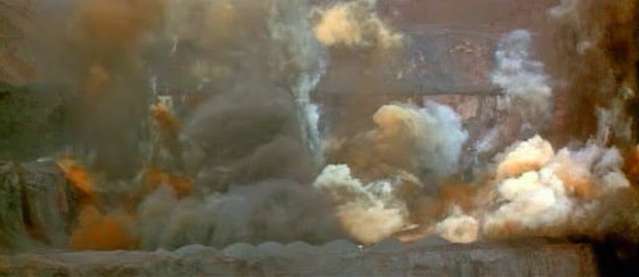
Another stylistic choice in terms of cinematography were the slow motion shots that played close attention to detail. For example, after the bomb detonates in the first scene, the bomb specialist is propelled into the air by the blast. This same shot is seen from various angles numerous times.
  
Another example is during the desert sniper scene when a slow motion shot is shown of the bullet shell tumbling on the ground after the bullet was shot. These examples of slow motion and attention to detail achieves to add to the already present tension and perhaps just slow down for a second for the audience to take a breath and catch up with the action and tension in the scene.

The editing in the film is varied and takes advantage of some very simple techniques. Such techniques are the use to fast cuts during action packed scenes and lengthy shots, almost to the point of awkwardness. For example, the editing helps to build tension in scenes by utilizing fast cuts of everyone present in the scene. Like I mentioned earlier, this helps by placing the audience in a situation that is disorienting and confused. By assaulting the audience with a parade of images, the audience is forced to process everything being shown, thus making it difficult to comprehend. The editing also uses lengthy shots during the conversation between Sanborn and James after James was unable to disarm the bomb on the suicide bomber. Sanborn confesses that he can no longer handle the stress that EOD tasks present him and wishes to live a normal life. This critical scene in the movie define two completely different characters. By utilizing lengthy shots, the film is given a sense of realism and helps deliver the conversation without any interruptions that could be caused by cuts during the dialogue.

One image that the film uses constantly is the Advanced Bomb Suit (ABS). This image is used throughout the film not only just for narrative purposes, but also seems to have underlying symbolism to it. It is first seen in the opening scene of the film. Here it suggests that it may not be the best form of protection for the bomb specialist to use, thus opening a sense of vulnerability to anyone wearing the suit. When James dons the suit, audiences are skeptical on whether or not James is safe, considering his reckless attitude. Throughout the film the suit virtually signals that a scene will create tension. And at the end of the film when James puts on the suit after he reenlists, symbolizes his ambition and his one love. This suit serves many purposes in terms of symbolism. Although it is something that traditionally is very protective, it also symbolizes vulnerability because no one is actually 100% safe while wearing the suit. It conveys a message that although the person in the suit seems well protected, they are still gambling with their life. This suit is also very much associated with the character of James. The ABSs are perhaps his most treasured tool that he is equiped with.


The narrative is crafted around an EOD squad that is responsible for finding and diffusing bombs in the battlefield. It tells a story around this team and the tasks they are charged with. By using this predicament, the narrative is able to achieve well crafted characterization of these 3 characters. James is a newly assigned leader for the Bravo team, Sanborn is responsible and is true to his role in the team, and Eldrige is a young specialist who helps show the fears of young soldiers at war. By creating 3 contrasting characters, the story needs very little action and plot substance to carry the story. Instead, this character driven story manages to entertain with action filled scenes, and create multi-dimensional characters.

This film won the Oscar for Best Picture for a reason. Not only was it masterfully directed by Kathryn Bigelow, the story, cinematography, script, and editing helped to make this film extraordinary. It's relevance in a time of constant warfare helps connect to a modern audience in a way no other film of this background can manage.

Sunday, November 21, 2010

Short Film Critique: Reminiscience

A. Rationale
With this film, I wanted to craft a story around a woman who remembers a distant memory about a specific period during her high school experience by looking through an old yearbook. During this period she is constantly being bullied by a boy(Justin), but instead of revealing that another boy(Tim) is helping her, only the bullying scenes are initially revealed. Only when she finds an old picture of her and Tim does she remember how he would help her out after she was bullied.

Maria, Justin and I wanted to pursue this story because it seemed like it would be relatively simple to shoot, yet very effective because of the twist at the end with Tim being a romantic partner with the female protagonist. We liked the idea of a story that was about bullying, but also at the core was a romance.
Since this film needed to connect with Amelie, we incorporated a male protagonist that isn't immediately revealed to be a protagonist, but instead remained a mysterious onlooker that would later help the female protagonist.

B. Commentary
For this film, I was the director/cinematographer and I was the editor for my particular edit. Because I was the director and the cinematographer, my main responsibility was to make sure that we approach the script in a way that most effectively conveyed the story through filming all of the scenes that were necessary in order to have a coherent plot. As cinematographer, I made sure that all of the scenes were shot from multiple angles in order to achieve a more dynamic feel to the scenes. Because I felt that shots that lasted long only made the movie seem boring, I utilized various angles and shorter cuts to help make the film a little more interesting.

One of the main problems we faced was trying to schedule an adult version of the male protagonist to show up in a final scene that showed that the two of them ended up getting married. Because we were unable to shoot this scene, I had to end the film in a flashback that essentially would give the same feeling of closure that the original intended scene would have brought to the film. This scene was the last scene that showed the origin of the picture that the older version of the female protagonist finds in the old yearbook.
I thought that our choice of actors and actresses contributed beneficially rather than take away from the film. The female protagonist, Maria, did a great job in expressing confusion in the scene after she was kicked, annoyance after her books were dropped, and awkwardness during the final scene. Justin, the bully, executed his actions better than expected and Tim, the male protagonist, was able to convince me that he was the "knight in shining armor". Overall the acting was well done and was able to add to the story rather than be a burden that film must carry.

As for mis-en-scene, we arranged boxes in the first scene of the film to show that the adult female protagonist was looking through old boxes so that it would be very likely that she would find an old yearbook packed inside a box. We wanted the boxes to convey that she accidentally finds the old yearbook, rather than is intentionally looking for it. This gives a slight sense of wonder because the series of flashbacks would be coincidental.
For my choice of music, I made sure that the music would add to the mood during the scenes. For example, when the bully knocks over the female protagonist's books, I made the undertone of the sinister music faintly playing under the main soundtrack overpower the main soundtrack and crescendo right at that moment. Another example of attention to detail with music was during the beginning of the formal night scene. When we are shown the male protagonist knocking at the door and we see that the female protagonist opens the door, the score was mysterious and uncertain, and again, crescendos right when we see the male protagonist's face.
One particular field that I was proud of was the match action cuts I was very careful able during the editing process. I made sure that every shot flowed into the next so not only did I made sure that our shots during the production process were lengthy enough to match action, I cut the film so that there were no disruptions with continuity. For example, when the male protagonist turns around to help the female protagonist, I cut the film so that the male protagonist's action in the first shot matched the second.


In order to achieve the sense that the adult female protagonist is actually looking back in time, I used a black and white filter to give a sense of flashback and a dip-to-color: white transition after the scenes where she is looking through the yearbook. Because we had a scene depicting a flashback within a flashback, we had to make sure that the scene wouldn't be confusing. The use of transitions and color tinting helped me to not confuse the audience.
When I was watching my edit of the film in class, I noticed a slight hiccup that perhaps no one else noticed. Because transitions take a little bit of film from the ends of both clips, the beginning of one clip was not trimmed properly and I was unable to catch it during editing.

Overall, I am very proud of my first film because I paid a great a lot of attention to detail not only during the production process, but also during the post-production process. Although we were unable to shoot a scene and I left in a rogue frame that shouldn't have been present, I can say that this is easily my best film to date, not just because its my only film.

Tuesday, November 16, 2010

Documentary Pre-production

Purpose: To inform people of the Japanese Art of Taiko drumming

Contacts: Sensei of the dojo, drummers/students, maybe some parents, maybe some experts opinions

Interview Questions:

What is Taiko drumming?
Talk about the history of the art
Describe some of the techniques involved.
What made you want to teach Taiko drumming?
When did you first begin Taiko drumming?
Who taught you?
Take me through a daily practice
What are performances like?

Many more of the questions will be a result of impromptu questions for expanding on ideas brought up during the interview.

General Flow:

The Beginning will entail a brief intro of the art, history through scenes of drumming performances, practices etc
The Middle will go into more personal stories with Taiko drumming maybe any struggles
The End will show resolutions to struggles and future prospects in America

Shot List:

Contain establishing shots of the city, dojo
Shots of drumming, CU etc
Maybe go more into shots of just the sensei
Too much shots to just list

Scripts:

Most if not all of the narration will come from interviewee commentary
Our voice overs will sounds too unprofessional
Maybe one or two shots of the interviewer asking the question

Intro:

Est shots of city around dojo LONG SHOTS, then closer maybe to streets, driving by shots, then focus into dojo (with drumming as the music score)

Closing:

Maybe shots of sensei packing up to go, closing the door to signal ending

Sunday, November 14, 2010

Short Documentary Review: "Beating the Unbeatable: Joe Wise"

"Beating the Unbeatable: Joe Wise" is about a 15 year old who was diagnosed with Mitochondria Myopathy, a disease that affects the mitochondria in his cells. Because of this, he can't be as active aas other kids his age. Instead he swims, and thats whats essentially keeping him from being in a wheelchair with life support.


This documentary was actually engaging compared to others because it captured my interest through the focus on swimming. Me being a swimmer was drawn in to the various depictions of the pool environment and the idea that Joe Wise actually made it to 5th place in a Paraplegic Swimming event in Beijing.


This story was extremely effective because it tells of a success story and how someone overcame their handicaps and exceeds expectations. Many of the shots shown corresponds well with the story being told. The story begins with a vague exposition of people he knows commenting on his disability. Then once you meet Joe, you are curious what is actually affecting him because he seems like a normal person.


This documentary works because it is structured extremely well. It begins with an explanation of the disease. This exposes viewers to his disability and the audience begins to sympathize with him.


As the documentary goes on Joe elaborates more on how this disease has effected him, and how swimming has saved him. You now think that yes, it is a miracle that he is still alive due to swimming. But no, the story isn't over, that isn't the the miracle. Not only did he overcome the restrictions of his disability, he made it to Beijing and finished in the finals of his race in 5th place.

Baraka Review

Why does the film Baraka not have any obvious or conventional uses of plot? Why no dialogue? Perhaps because the title of the film means "breathe" or "essence" in Persian Sufi. In this respect, the film attempts, and in many ways, succeeds in bringing the essence and purity of life on screen. Instead of suffocating the majestic aspects of life with a plot, the director gives the audience a pure interpretation of life, freed of any forms of restrictions (well except the fact that it is a movie rather than the actual locations of course).

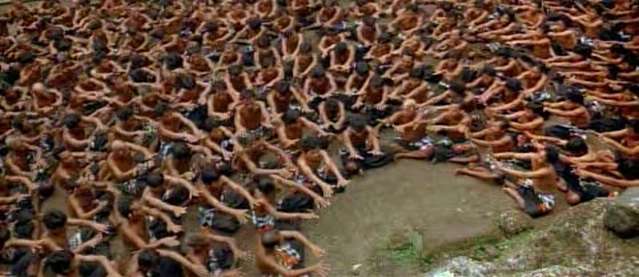
The film is a critique of the modern world and the oppression it brings to the purity of the planet and it's geographical elegance. It criticizes industrialism, modern man's conquests for wealth and progress, and attempts to capture the essence of tribal life and all that it represents with a long sequence that shows a tribal dance that would be otherwise unknown to the everyday man of the modern world.


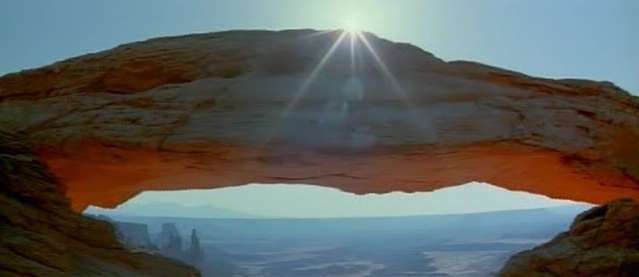
The cinematographer typically begins a sequence with a majestic view of earth, yet the true majesty of the location is not immediately revealed with the beginning of the shot. In this particular shot, the camera dollies to reveal the vast landscape, beyond the geographical formation initially revealed by the opening shot of the sequence.


By contrasting sequences of urbanization and nature, urban life that is shown as organized and seemingly restrictive, where on the other, nature is unrestricted and free.